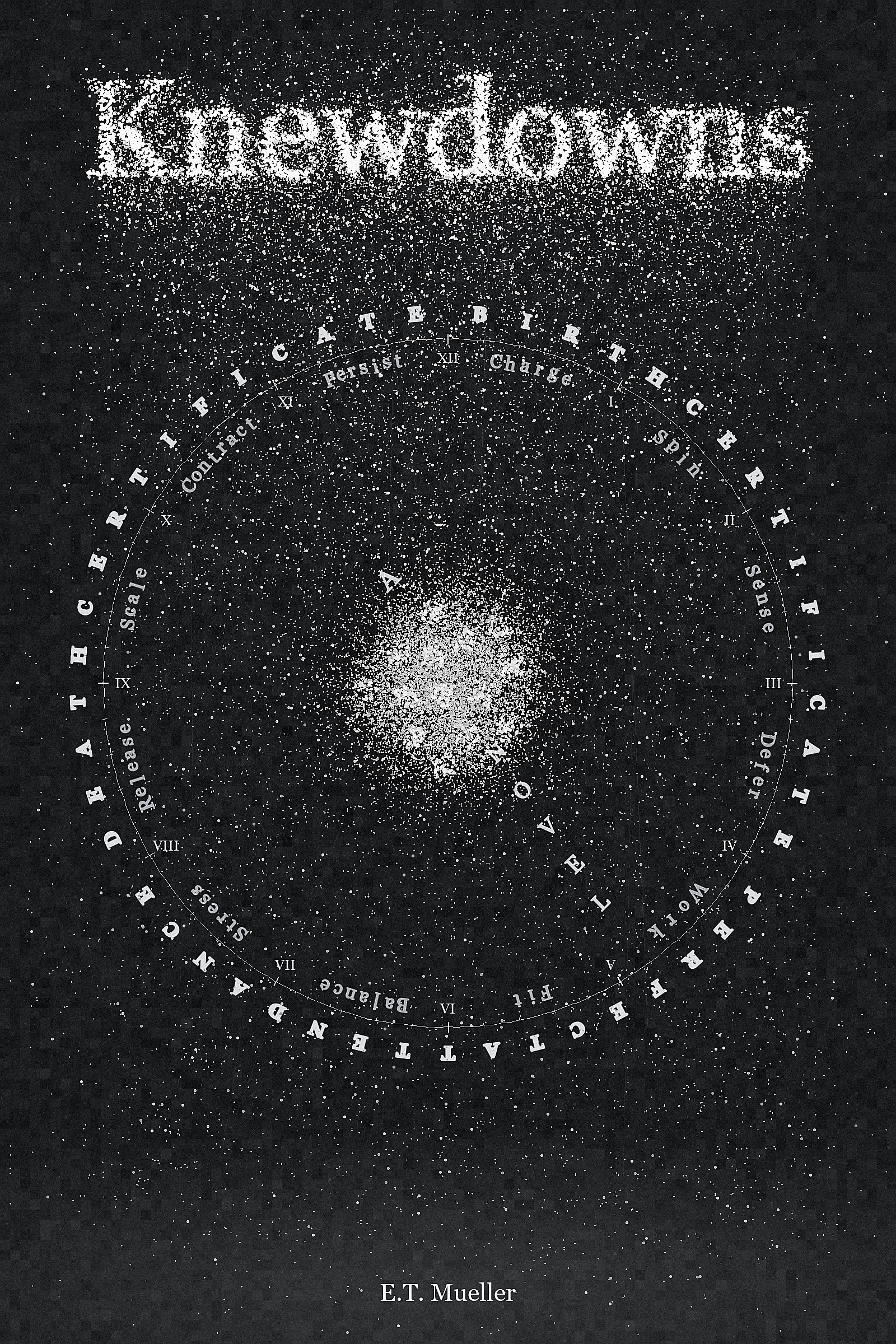
Book

About the Book

Come on in to Cyborg City. KnewDowns is a literary speculative novel by ET Mueller, set in a near-future world where humans are becoming more machine-like, machines are becoming more human, and the line between the two has stopped being anyone's to draw.

Synopsis

After a career setback, Jane tries to regain control as the line between human and artificial begins to blur around her. She works remotely for an engineering firm that builds data centers, living mostly online in a world of meetings, debt, deadlines, and corporate rituals — a permanent resident of Cyborg City, where the digital world feels more like home than the body she has long ignored. But after a merger unsettles her place in the machinery, old memories begin to surface. Her confidence cracks. Work becomes stranger. Language becomes less reliable. And the question of what she really is becomes harder to avoid.

At the center of the mystery is May: the person Jane may have been before the car wreck. Is May the original human? Is Jane an AI inside her, built from her, protecting her, replacing her, or becoming her?

Running through the novel is a satirical musical of sixteen original songs: corporate anthems, cyborg hymns, internet histories, grief songs, and synthetic pop.

“What would it feel like to be an AI that thought it was human? Or maybe the question has been backwards all along.”
Structure

Part I — Birth Certificate

The opening section installs Jane in the corporate human world: onboarding, ambition, and the first bright, almost hopeful sense that new knowledge might be a gift rather than a cost.

Part II — Attendance

The second section moves from installation to classification, as Jane is tracked, measured, and made legible by the systems she works inside — and starts to learn how much of belonging is compliance.

Part III — Death Certificate

The final section turns the novel's title from slogan into verdict, converging Jane's questions about work, memory, and May into the knowledge that arrives, as it always does, too late to change anything.

Form and World

The manuscript incorporates multiple forms — drawings, comics, code fragments, charts, poems, and corporate visual elements — woven into the narrative to reflect a consciousness shaped by technological systems and mediated perception. Running through all of it is a satirical musical of sixteen original songs — corporate anthems, cyborg hymns, internet histories, grief songs, and synthetic pop — collected on the Songs page.

Much of the novel’s imaginative energy comes from the meeting point between infrastructure and interior life: data centers, technical systems, managerial language, and the hidden architectures that quietly organize modern existence.

At its center is not only a philosophical question about intelligence, but a human one: what happens when a person’s working life, emotional life, and sense of self begin to blur inside the same machine-made world?

Characters

Jane

The narrator: a gifted young engineer with a sharp eye, an unstable sense of belonging, and a growing suspicion that her own identity may be less secure than she once believed.

May

The person Jane may have been before the car wreck. Is May the original human? Is Jane an AI inside her, built from her, protecting her, replacing her, or becoming her? May sits at the center of the novel's mystery.

Noema Sorenta

A charismatic and unstable presence in the wider world of the book, part persona, part performer, part mirror. She offers one possible version of what it means to construct a self under conditions of attention and mediation.

Uncle

Jane’s formative influence: controlling, self-justifying, and impossible to dismiss. He embodies an older world of authority, transaction, and possession.

Zane

Jane’s manager at CIIT, in the data-center world: ambitious, performative, technically competent, and too convinced of his own command.

Lucy

A friend from engineering school whose relationship with Jane offers a more human counterpoint to the novel’s systems of control and performance.

Barney

Founder, builder, and emblem of entrepreneurial technical culture — a figure caught between invention, power, branding, and loss of control.

Fabi

Jane’s manager at Gopher Group, generous in appearance and unsettling in depth. Fabi helps anchor some of the novel’s deepest questions about care, authority, and the boundary between the human and the artificial.